
Female Reproductive System & Fertility
Natural ovulation cycles
Natural conception takes place when a healthy sperm fertilises a healthy egg in a woman’s body. In order for this process to take place you need ovulation to occur and a clear pathway for the egg and healthy sperm through the Fallopian tubes.
Every month from puberty to menopause, an egg is released from a follicle within one of your ovaries. In natural ovulation, each month your ovary starts to grow several follicles, one of which goes on to ovulate.
Two hormones are responsible for the development of follicles within your ovaries:
- Follicle stimulating hormone (FSH), and
- Luteinising hormone (LH)
The cells in the follicles also produce oestrogen and progesterone. Your hormone levels will rise and fall at different stages of your monthly cycle. If the egg meets a sperm somewhere in your fallopian tube, fertilisation may occur. Once cell division begins, an embryo travels down the Fallopian tube to your uterus, where it should implant in the endometrium. This typically happens about seven days after ovulation.
For women, your ability to become pregnant can be affected by your age and common female fertility conditions such as polycystic ovarian syndrome and ovulation disorders, endometriosis, blocked fallopian tubes and uterine fibroids.
Your pregnancy window
When you get your period, the ovary starts to develop a number of follicles, one of which will become the egg destine to ovulate. A follicle is a small fluid-filled sac containing an egg.
Ovulation occurs after about 14 days on average, when the egg matures and is released. The egg can survive for about 24 hours.
Your pregnancy window is the fertile time leading up to ovulation and fertilisation.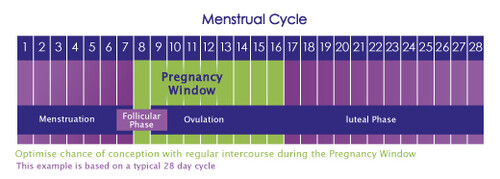
Once you know your pregnancy window, ensure you have sexual intercourse at least every two days during that time. Sperm will survive and retain fertilising ability for two to three days in the Fallopian tubes.
We don’t recommend using temperature charting as your temperature rises after you ovulate, and you need to have intercourse before ovulation. If you are concerned about your menstrual cycle, we can carry out tests to see what is happening.
How do I know when I ovulate?
Every woman is different, and your cycle may also vary month to month. Typically, an ovulatory cycle will be between 24 and 35 days in length. The time from the start of your period to ovulation could be as short as eight days, or as long as 21 days. The time from ovulation to menstruation is more consistent at 11 to 17 days, with an average of 14 days.
To work out when you ovulate, subtract 14 days from the number of days in your cycle. So if your cycle is usually 28 days, you can expect to ovulate on day 14 (between day 12 to 16). It might be helpful to use a urine ovulation detection test during your pregnancy window.
What causes infertility?
Infertility has been historically defined as a couple not conceiving after 12 months of regular unprotected sexual intercourse. Current data show that most couples will conceive within six months of trying, so best practice now suggests you seek a fertility assessment if you are not pregnant within six months.
Apart from increasing female age, infertility can be caused by problems within the female reproductive system, such as ovulation failure, tubal disease or endometriosis (about 40% of cases), or with sperm (again, about 40% of cases). In at least a third of cases there are both male and female factors causing problems.
To conceive a healthy baby you need a healthy egg and sperm to meet in the right environment at the right time. Sometimes this isn’t as easy as it sounds.
Both female and male factors can affect fertility so understanding how both reproductive systems work is crucial.In 40% of infertile couples the cause is due to a sperm factor, in 40% it is due to ‘female factors’, such as Polycystic Ovarian Syndrome (PCOS) or endometriosis and in one third of couples it is both male and female factors combined.
For women, the most common causes of infertility include:
- the woman's age
- problems within the female reproductive system such as endometriosis, fibroids, PCOS and tubal disease
- irregular periods, generally caused by ovulation disorders
- blocked fallopian tubes which may prevent the sperm from meeting with the egg
- sexually transmitted infections (STI's)
If you’re trying to conceive it is important that as a couple you assess your current lifestyle choices to avoid smoking, excessive drinking, being under or overweight to give you both the best chance of starting a family.
Understanding the female reproductive system
Female Reproductive System

How do I track my cycle and when should we have sex?
Understanding how a woman’s reproductive system works is the first step to getting pregnant. Watch our Fertile Minds YouTube video, on how to accurately track your cycle to determine the best time to have unprotected sex. Dr Fleur Cattrall explains.
Understanding your menstrual cycle
Learn about ovulation cycle tracking
Female fertility testing