Medical Female Fertility Preservation
There are many young women whose fertility may be threatened by cancer or other serious diseases and the treatment for these conditions.
Medical fertility preservation aims to protect and preserve fertility for the future using various treatment options. For women, these can range from freezing of eggs, embryos and ovarian tissue, as well as medications which may protect the ovaries from chemotherapy. For some young women and their families, it may not be suitable to pursue fertility options prior to cancer treatment. Though having the opportunity for discussion about your future fertility may be helpful.
Enquire Today
What is egg freezing?
Egg freezing (oocyte cryopreservation) is the process of storing a woman’s unfertilised eggs for use in the future and is considered an established option for women, with thousands of babies born worldwide from this technique in the last few years. Melbourne IVF fertility specialists see this as a way of preserving the potential for fertility in women whose fertility is at risk due to age or medical treatment and who are not currently in a position to become pregnant.
To obtain eggs for freezing, a woman will usually undergo hormonal stimulation over 10 – 12 days enabling a number of eggs (usually 10 – 15) to mature. The eggs then undergo a freezing procedure called vitrification. When the woman is ready to use her eggs, they are thawed and then fertilised with sperm using in-vitro fertilisation. Resulting embryos may then be transferred to the woman’s uterus with the hope that a successful pregnancy will occur.
Depending on the circumstances, a woman may have enough time before starting chemotherapy or radiotherapy to have more than one cycle of hormone stimulation and egg retrieval. This ensures that a reasonable number of eggs are frozen and therefore an increased chance of a future pregnancy.
Read more information about egg freezing
Download an egg freezing brochure below.What is embryo freezing?
If you have a male partner with whom you are planning to have children, you may choose to undergo in vitro fertilisation (IVF) treatment prior to commencing chemotherapy or radiotherapy. Any resulting embryos can then be frozen and used for future pregnancy attempts, often years later.
An IVF cycle involves 10 to 14 days of hormone stimulation prior to the woman’s mature eggs being collected in day surgery and fertilised with her partner’s sperm in the laboratory.
In undergoing this option, it’s important for young women to understand that if the embryos are created that if you and your partner subsequently separate, you will require the permission of your ex-partner to use the embryos.
How can cancer treatment affect my fertility?
Some chemotherapy drugs can damage the eggs and follicles in a woman’s ovaries, which can temporarily or permanently damage your fertility. The effect on fertility will depend on your age with an increasing risk as you age. This is because as a woman gets older there are fewer eggs in the ovaries making them more vulnerable. Effects can include:
- Short-term ovarian failure: temporary stopping of periods which return over 3-12 months
- Permanent ovarian failure: occurs with very high-dose treatments. In this situation the ovaries stop working because the eggs have been too badly damaged
- Delayed permanent ovarian failure: occurs a few years after chemotherapy treatment and is the most common. It usually occurs during the time when you would have recovered from the cancer and want to start a family
Radiation treatment (radiotherapy) if directed to the pelvis can also cause damage to the ovaries and sometimes to the uterus. For some cancers, surgery is required which can either require removal of the ovaries or disturb the function of the Fallopian tubes.
Ovarian protection during chemotherapy
There are some medications called GnRH analogues that may reduce the damage of chemotherapy drugs on the ovaries. GnRH analogues protect the ovaries during chemotherapy by putting them in a dormant and non-functioning state to suppress a woman’s normal menstrual cycle. This is thought to reduce the eggs’ exposure to the damaging effects of the cancer treatment.
GnRH analogues are monthly injections taken during the time of chemotherapy treatment. Women may experience hot flushes which tend to begin after the second injection is administered. Fortunately, this side effect and the suppressing effects are only temporary and there are no lasting side effects of the medication after the therapy finishes.
Ovarian tissue freezing
Ovarian tissue freezing is an emerging treatment option with a small number of babies having now been born using this technique. Ovarian tissue freezing involves removing a small piece of ovarian tissue from the ovary, and preparing it into tiny slices and freezing the tissue. Later, when you are ready to conceive, the ovarian tissue is grafted back into your pelvis. Around nine months later, the grafted ovarian tissue can start to produce reproductive hormones with subsequent follicular development. Pregnancy using grafted ovarian tissue is achieved with a modified, low-dose gentle cycle of ovarian stimulation and in vitro fertilisation (IVF).
There have been some reported cases in which women have conceived naturally after ovarian tissue grafting. This treatment option has until recently been considered experimental and while it is an increasingly successful option for some women, further research is still being conducted to maximise the safety and success of this treatment.
Fertility preservation research at Melbourne IVF
Melbourne IVF has been involved in extensive research for more than 20 years on ways to protect and preserve fertility in women and men who need treatment for cancer.
We are currently developing new ways to help protect fertility during chemotherapy or other therapies that can affect the reproductive organs. Our research focuses on techniques to preserve mature eggs or ovarian tissue before chemotherapy, radiotherapy or surgery. This research was the first of its kind in Australia and provides leadership and expertise to other clinics around the country.
Read more about the current research projects at Melbourne IVF…
Getting started
To book an appointment or find out more about a medical fertility preservation appointment, please contact our Community Liaison Administrator on 1800 111 483.
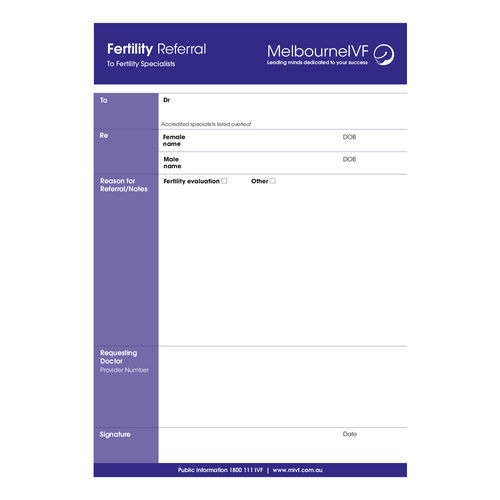
If you are having treatment which puts your fertility at risk, or you have other risks to your fertility you should arrange an appointment with a Melbourne IVF fertility specialist. Prior to this appointment you will need a referral from your GP or specialist. Download our fertility referral form below.
Your fertility specialist will discuss any risks associated with your fertility treatment, including the extent of the planned medical treatments or delay in commencing a family. Your fertility specialist can then advise you of the best options for your individual situation. This initial appointment gives you the opportunity to discuss your personal circumstances, become informed about the risks to your fertility and learn about different fertility-protecting and fertility-preserving options. It also helps establish the contact with your fertility specialist. After the cancer or other fertility-compromising treatment has been completed, you will need to have your ongoing potential fertility and hormonal issues assessed and managed. You may also wish to consider other future options, such as donor sperm, eggs or embryos.
The fertility specialist will take a medical history, arrange any necessary investigations (including blood tests and ultrasound assessment of the ovaries) and arrange a counselling referral if this is required or requested.
Treatment costs
In Australia, Medicare and other government subsidies may apply to medical fertility preservation where a woman’s fertility is affected or likely to be affected by conditions such as tumours of the ovary, chemotherapy, radiotherapy and/or other medical indications.
For an explanation of the costs associated with medical fertility preservation, please call our Community Liaison Administrator on 1800 111 483 or fill in the form below.
Download Additional Resources
Fertility options for young women having chemotherapy and radiotherapy: Can I still have children? Download below.