
Anti Mullerian Hormone (AMH) Test & Ovarian Reserve
What is the Ovarian Reserve?
Ovarian reserve refers to the number of viable eggs that are left in a woman's ovaries. Unlike men, who produce sperm throughout their adult life, women are born with their lifetime supply of eggs. The quality of these eggs declines steadily over a woman's lifetime and by the age of 36 starts to decline rapidly.
Enquire Today
Egg reserve test
Anti-Mullerian hormone (AMH) is a hormone secreted by cells in developing egg sacs (follicles), and the level of AMH in a woman’s blood is a good indicator of her ovarian reserve.
The AMH test can provide an insight into the remaining quantity of eggs and number of fertile years a woman has remaining, although it does not give any information about the quality of the eggs. AMH does not change over the course of the menstrual cycle, so it can be tested through a blood sample at any time of the month. It can also be tested while you are using hormonal contraception.Do I need an AMH test?
The AMH test may be useful if:
- you have been trying to conceive for over six months and would like reassurance that your ovarian reserve is appropriate for your age;
- you are considering IVF or other fertility treatments, since low levels of AMH may indicate a potentially poor response and, conversely, a high level may indicate an exaggerated response to IVF medication;
- you have had chemotherapy or ovarian/endometrial surgery and want to find out if it has affected your ovarian reserve;
- you would like to conceive in the future and would like to understand more about your current ovarian reserve.
It is important to understand that ovarian (or egg) reserve is not a measure of fertility but an important tool in assessing potential fertility.
What will an AMH test tell me?
An AMH test gives us some insight into the remaining quantity of eggs and number of fertile years you may have. It’s important to note, however, that the AMH test cannot tell us much about the quality of those eggs.
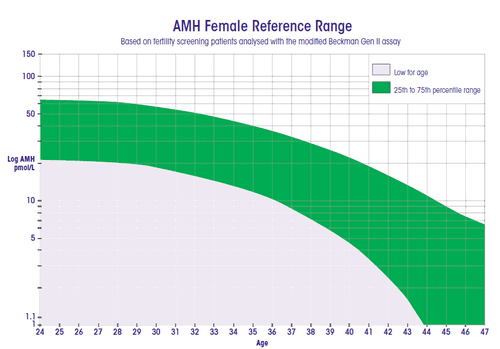
To interpret your results, your doctor or fertility specialist will compare your own level with other women of the same age.
How do I get an AMH test?
You can ask your fertility specialist or GP for a referral for an AMH test. This may be done at your nearest Melbourne IVF clinic. Results are usually available within a week and will be sent to your referring doctor. An AMH level <14 pmol/L is indicative of a lower ovarian reserve and you may then wish to consider discussing this with a fertility specialist.
How much does an AMH test cost?
The test costs $90 and is not covered by Medicare.
What if I have a low AMH?
If you have a low AMH level, indicating poor egg reserve, your GP may consider referring you to a fertility specialist for further explanation or you can simply book an appointment with a fertility specialist to discuss your options.
It is important to remember that women that have low ovarian reserve and women that have high ovarian reserve fall pregnant naturally at exactly the same rate. The reason for this is that both groups ovulate one egg per month and AMH is not an indicator of egg quality. However, AMH is a useful tool to predict response with IVF, in terms of likely egg number that will be obtained in an IVF cycle. It can also give advanced warning that ovarian reserve is declining, prompting women to explore their reproductive options sooner.

Age is the most important factor in a woman's fertility, and an AMH test can assess your current fertility.
Read more about female age and fertility
Meet our fertility specialists